


GRANTURI ȘI FINANȚĂRI
- Detalii
- Categorie: Granturi
Call for expressions of interest for EU/EEA/Moldova-based businesses to invest in the Republic of Moldova
Informațiile prezentate în articolul de mai jos pot să nu mai fie actuale sau să nu mai reflecte activitățile și programele curente. Anunțul este păstrat în arhivă pentru a asigura transparența și accesul public la informațiile despre inițiativele și proiectele implementate anterior.
1. Purpose of the Call
Moldova’s strategic path toward EU Integration
Moldova is building the foundation for its integration into the European Union’s Single Market — not only through legal alignment, but by upgrading its infrastructure, energy systems, digital services, institutions and the agri-food sector. These efforts are not isolated reforms, but part of a strategic objective to position Moldova as a future EU member and a key link in Europe’s economic and logistics networks.
A favourable environment for strategic investment
While support for private sector development has so far focussed on access to finance for SMEs, this will now be complemented by a strategic approach aimed at attracting and supporting strategic investors. Moldova offers direct infrastructure connections to Romania and Ukraine, free access to the EU market, and a skilled labour force. The government is committed to a rules-based, business-friendly environment, backed by technical and financial instruments supporting investments (see: Invest - Invest Moldova).
Reform and growth commitment
Under the Moldova Growth Plan and the EU-funded Reform and Growth Facility, the country is implementing more than 150 reforms between now and 2027 to improve competitiveness, simplify procedures, and align Moldova’s economic system with EU norms. (Link: Planul de creștere al Republicii Moldova 2025-2027 – Ministerul Dezvoltării Economice și Digitalizării)
Digital transformation and ICT sector
More than 80% of entrepreneurs interact digitally with the state, and over two-thirds of public services for businesses (e.g., permits, tax, and customs) are digitalized. This digital transformation is underpinned by high-performance infrastructure. The country has 90% gigabit internet coverage, 86% fixed broadband penetration, and 89% mobile broadband usage. Moreover, Moldova has positioned itself as a regional digital leader. The single-tax regime for IT firms has been extended until 2035, supporting a sector that now contributes over 7% to GDP—ranking Moldova 7th in Europe by ICT share and outperforming several traditional industries.
Industrial policy and manufacturing
Moldova has launched a new State Aid Scheme for Industrialisation to support high-value manufacturing. In parallel, multifunctional industrial platforms are being developed to attract investment and foster value-chain integration. To further streamline investment processes, the government will introduce a national Investment Map and set up a dedicated one-stop shop for strategic projects.
Logistics, transport infrastructure and air connectivity
Moldova is strengthening its role as a strategic logistics hub. The Berești multimodal terminal near Ungheni, just 5 km from the Romanian border, is expected to become the country’s first large-scale logistics platform—capable of handling both broad- and European-gauge rail wagons and accommodating up to 200,000 trucks annually. Once operational, the terminal will reinforce the country’s integration into European transport and supply chains. In parallel, the country is modernising key rail and road corridors along the TEN-T network. A dedicated program is also under way to restore major bridges and border infrastructure, essential for trade and safe mobility. The feasibility study for the Ungheni–Chișinău–Odesa highway is expected by the end of 2025. Finally, air connectivity is also improving. Chișinău International Airport recorded a 46% increase in passengers in 2024 compared to 2023, while Mărculești International Airport is being transformed into a regional hub for cargo and seasonal passenger flights.
Energy security and market integration
In the energy sector, Moldova aims at achieving a higher degree of energy resilience, energy security and self-reliance and is taking concrete steps toward integration with the European market. The country is preparing for electricity market coupling with the EU, supported by the construction of three 400 kV interconnectors with Romania and synchronisation with ENTSO-E. The support for major infrastructure projects like the electricity interconnector with Romania and the development of stable generation capacity will be reinforced through implementation of an investment pipeline supported by the EU and International Financial Institutions. Moldova is advancing an ambitious renewable energy agenda, simplifying permitting procedures and accelerating investment in solar, wind, and biomass. These efforts go hand in hand with reforms to unbundle the gas sector, modernize storage infrastructure, and ensure transparent, market-based operations.
Governance, labour, and capital markets
Efforts to strengthen competition policy and reform State-Owned Enterprises (SOEs) are ongoing, aiming at privatising a number of companies and continuing with the corporate governance reform and restructuring in other SOEs. Moldova is enhancing skills of its labour force including through improved vocational education and training. It is also making progress on faster court procedures and improved access to justice. On the financial side, Moldova joined the Single Euro Payments Area (SEPA) in March 2025 — a key step toward deeper financial integration with the EU. The country also aims to develop its capital market and is preparing to open up to the Bucharest Stock Exchange, with plans to establish a joint market infrastructure that will support the integration of Moldova’s capital market with EU standards.
EU support instruments and call for investment proposals
The EU has several instruments which can facilitate investments of the private sector in Moldova. In particular, the European Fund for Sustainable Development Plus (EFSD+) offers some derisking opportunities through budgetary guarantees to partner International Financial Institutions and development banks, and where necessary grants for investments with wider public benefits.
More specifically, EU guarantees make it easier for International Financial Institutions, development banks and also private co-investors to provide loans or other financing for investment projects, at favourable conditions. EU guarantees can support a range of financing modalities, including debt, equity and portfolio guarantees for banks’ lending to the private sector. In addition, the EU also finances technical assistance support for investment preparation.
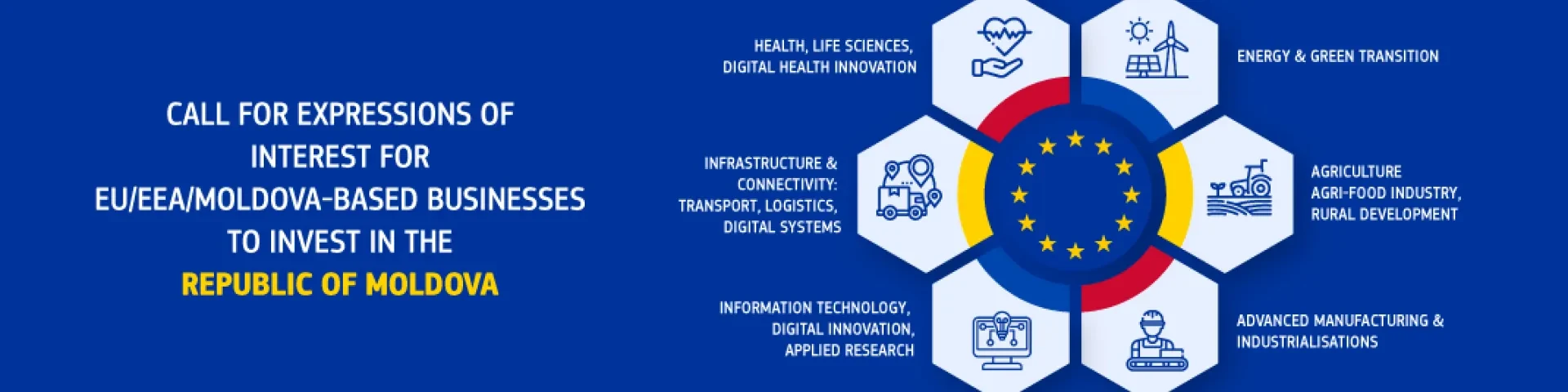
In this context, the European Commission is launching a Call for Expressions of Interest for EU/EEA/Moldova-based businesses to invest in the Republic of Moldova in line with EU strategic areas of interest and policy priorities.
2. Objective of the Call for Expressions of interest
The objective of this Call for Expressions of Interest is to enter into a dialogue with private companies on concrete investment opportunities and related constraints in the Republic of Moldova. Based on relevant assessment criteria, subsequent contact with partner Financial Institutions may be facilitated for potential financial cooperation. This dialogue is aimed at building a pipeline of transformative private investments in the Republic of Moldova that could be potentially supported by the European Commission with its available instrument
This Call invites EU/EEA-based and Moldova-based companies to submit project proposals for new investments into the Republic of Moldova’s real economy. Participation in this Call does not constitute any form of partnership, joint venture, or other legal relationship between the Participant and the European Commission. It does not constitute any guarantee of financial support neither from the European Commission nor any partner Financial Institutions. The publication of this Call for Expressions of Interest also does not commit the EU to finance the project investment proposal.
All project proposals presented to the European Commission will be assessed based on the criteria outlined in this Call and will be treated equally, ensuring a fair and transparent assessment process. All information submitted as part of the project proposal will be treated confidentially and used solely for the purposes of evaluating the proposals in accordance with the criteria specified in this Call.
The priority areas of the Call will be based on the Growth Plan for the Republic of Moldova (Planul de creștere al Republicii Moldova 2025-2027 – Ministerul Dezvoltării Economice și Digitalizării) and Strategic Orientations of the EFSD+, outlining key real economy sectors requiring Investments including but not necessarily limited to:
(i) Energy and green transition
Develop distributed sustainable energy solutions, including renewable energy, balancing projects and modernisation of existing energy infrastructure as well as energy efficiency solutions. Moldova is accelerating its energy transition through investments in distributed, sustainable energy solutions—ranging from renewable generation and now aiming for energy storage to the modernisation of critical infrastructure and energy efficiency upgrades to the buildings. Strategic priorities include the development of new electricity interconnectors, reinforcement of the national transmission and distribution grid, and the recently achieved unbundling of the gas sector to ensure energy security and supplies diversification. Moldova is also focused on enabling decentralised energy production and prosumer models, supported by simplified permitting processes and new support schemes for renewables that applied net billing mechanism. Public and residential building renovations offer significant opportunities for energy efficiency investments. Thanks to Moldova’s new Energy Sandbox Law, investors can now pilot innovative green technologies, services and processes in a flexible regulatory environment.
Green transition is one of the key priorities of the Reform Agenda under Moldova Growth Plan. Reform steps will help decarbonise Moldova’s economy and curb environmental degradation and pollution by improving environmental governance, advancing the transition to renewable energy, introducing elements of a circular economy framework, and improving the protection of biodiversity and preparing for further actions as stipulated in the Moldova’s Environmental Strategy.
(ii) Agriculture, agri-food industry, and rural development
Moldova emerges as a trusted agri-food supplier to the EU, particularly in premium quality segments. With government efforts focused on expanding irrigation infrastructure and modernising production, targeted investments are set to accelerate innovation, enhance productivity, and support the shift toward sustainable, high-value agriculture—especially in wine, fruit, and horticulture. Attractive investment opportunities lie, among others, in vertical integration, off-taker arrangements, and the modernisation of livestock and diary production, food processing and packaging value chains. The upcoming Agrotek Park will serve as a national hub for smart agriculture, agri-tech, and bioeconomy solutions—fostering research and the adoption of advanced technologies in farming. Moreover, with income from tourism having doubled over the past four years to reach €700 million, and improved international air connectivity, Moldova offers significant opportunities in eco-resorts, balneological centers, hotel infrastructure, and MICE (Meetings, Incentives, Conferences, Exhibitions) development.
(iii) Advanced manufacturing and industrialisation
Moldova is accelerating the modernisation of its industrial base, shifting from low-value assembly toward integrated, export-oriented manufacturing. Backed by the new National Industrialisation Plan, six strategic sectors—electronics, pharmaceuticals, automotive components, textiles, chemical products, and construction materials—are eligible for targeted support through a Regional State Aid Scheme that covers up to 75% of investment costs (60% for mid- to large-sized firms). Recent progress in electronic components, smart metering, and e-mobility points to growing potential in modern manufacturing facilities, quality assurance systems, and digitally integrated production lines. This transition is further reinforced by opportunities in clean technologies—including recycling and materials recovery linked to national waste management reforms—as well as in the production of energy components for the green economy. Investors can also explore innovative technologies, where Moldova’s growing tech base and strategic geography create a platform for scalable solutions in both civil and security applications. Having a 1,222 km border with Ukraine, Moldova is well positioned to play a meaningful role in regional logistics and post-war reconstruction. Its border regions offer natural platforms for industrial operations tied to reconstruction supply chains, particularly in building materials, construction services, and design engineering. These sectors serve both Moldova’s domestic infrastructure ambitions and the urgent rebuilding needs just across the border.
(iv) Information technology, digital innovation, and applied research
Moldova is home to Europe’s first fully virtual IT park which currently hosts over 2,300 companies from 45 countries. The park’s ecosystem is expanding, with growing investor interest in enterprise software, artificial intelligence, deep tech, and creative industries such as animation and game development. This is due to one of the region’s most competitive fiscal regimes: a 7% single-tax rate for IT companies, guaranteed until 2035; VAT exemptions for export-oriented services; and targeted incentives for R&D activities. These are complemented by a national startup fund (over €1 million) and a forthcoming Fund of Funds to catalyse private equity and venture capital flows into Moldova’s innovation ecosystem.
Moldova is launching two new innovation districts: (i) the Moldova HiTech Park, focused on AI, deep tech, and enterprise software; and (ii) the Agrotek Park, specialised in smart agriculture and green innovation. Both parks will serve as dynamic entry points for early-stage investors, R&D partnerships, and commercialization of emerging technologies. Moldova’s broader digital transformation is also unlocking cross-sector investment opportunities, with growing activity in BPO and IT-enabled services, cybersecurity, data infrastructure, and GovTech. The country is developing its national broadband coverage, digital platforms, and interoperability tools——creating new possibilities in smart product development, supply chain digitalization, and off-taker agreements.
Applied research is becoming a core pillar of Moldova’s innovation strategy. The government is expanding research infrastructure through shared labs, modernized university and vocational school facilities, and technology transfer platforms designed to bridge academic expertise with business needs. These initiatives align with the Smart Specialisation Strategy 2024–2027, which identifies agriculture and food processing, ICT, energy efficiency, biomedicine, and labour market-aligned skills as Moldova’s strategic innovation priorities.
(v) Infrastructure and connectivity: transport, logistics and digital systems
Moldova is rebuilding and modernising its infrastructure through a dual-track effort that targets both physical and digital connectivity. This integrated approach—covering transport, logistics, broadband, and digital systems—is a core part of Moldova’s EU accession agenda and is backed by strategic reforms designed to attract investment and align with European standards. In cooperation with the Transport Community, Moldova is also drafting a package of legal acts to approve and transpose its National Intelligent Transport Systems Strategy which will accelerate the digitalisation of mobility and strengthen connectivity across the entire transport system.
Roads, railways, bridges, and customs infrastructure are undergoing accelerated upgrades. Moldova’s national road and rail networks are now formally integrated into the EU’s Trans-European Transport Network (TEN-T), ensuring compatibility with EU core and comprehensive transport corridors. Major rail segments along the North–Center–South corridor are being rehabilitated with EU support, and a prefeasibility study is advancing for the modernisation and electrification of the Ungheni–Chișinău section—crucial for future integration with Romania and the EU network. Moldova is also rapidly aligning its transport legislation across all modes (road, rail, air, and maritime) with the EU acquis, providing legal certainty for investors operating under EU-standard rules.
Strategic investment entry points are also emerging. The Berești multimodal logistics hub, located just 5 km from the Romanian border, is positioning Moldova as a key transit node between East and West. The Giurgiulești Free Port is undergoing expansion via a global investment tender, and with EU support, Moldova is conducting a feasibility study for a new logistics hub in Chișinău to enhance its role as a regional distribution center. These developments open up private capital opportunities in freight terminals, integrated warehousing, last-mile distribution, and customs-linked infrastructure. Moldova’s participation in the EU’s Connecting Europe Facility (CEF) provides access to targeted funding for strategic border infrastructure projects aligned with EU regulations.
In parallel, Moldova is advancing its digital connectivity systems. Reforms include broadband rollout in underserved regions, the creation of 5G-ready transport corridors, and the integration of customs and logistics platforms into national e-government systems. These reforms generate new opportunities for private investment in secure digital infrastructure, real-time supply chain monitoring, and smart mobility services that complement the country’s physical logistics backbone.
(vi) Health, life sciences, and digital health innovation
Moldova’s pharmaceutical and healthcare sectors are undergoing strategic transformation, backed by regulatory modernisation, industrial policy, and a growing digital health agenda. The 2025 Law on Medicines has established the legal framework to strengthen regulatory oversight, streamline access to essential medicines, and enabled broader participation in clinical trials—helping align Moldova’s pharmaceutical system with EU standards and creating space for innovation and international investment. The government is also prioritising the development of local pharmaceutical manufacturing and supply chain diversification. Moldova’s pharmaceutical market is projected to grow at a compound annual growth rate (CAGR) of 3.22% through 2029, driven by regulatory upgrades and rising demand for high-quality, affordable medicines.
Alongside pharma, healthcare infrastructure modernisation is gaining momentum with EU and IFIs support. Investment opportunities span the construction and renovation of hospitals, clinics, and diagnostic centers, with a new emphasis on environmentally sustainable medical infrastructure that aligns with Moldova’s climate change and green public investment commitments. Digital health is a central pillar of Moldova’s reform path. Following the rollout of a national e-prescription system in 2025, upcoming investment prospects include the deployment of electronic health records, telemedicine platforms, data-driven diagnostics, and interoperable IT systems. Meanwhile, Moldova is emerging as a competitive medical tourism destination, with over 36,000 international patients annually. The country attracts growing interest for high-quality dental care, aesthetic surgery, fertility treatments, neurology, and post-operative rehabilitation, offering an attractive mix of affordability, expertise, and quality service delivery. Several cross-cutting reforms under the Growth Plan Reform Agenda, including in digital public services, procurement modernisation, and public investment management are laying the groundwork for stronger private-sector involvement in health and life sciences and will support long-term investment in hospital infrastructure, diagnostics, and local pharmaceutical production.
3. Eligibility Criteria
Eligibility Criteria
To ensure a structured and transparent assessment, the following criteria will be used for evaluating the eligibility of project proposals:
- Geographic Area: Republic of Moldova (investment taking place on the territory of the Republic of Moldova).
- Private Sector: Eligible Participants to the Call shall be private enterprises, joint venture or consortium of companies, possessing a valid VAT registration number (note: Entities without a valid VAT registration number will be excluded from this Call for Expression of interest). Entities listed in the Early Detection and Exclusion System (EDES) ([1]) data base are excluded from this Call for Expressions of Interest. If the project is conducted by a consortium, the consortium leader must be based in the EU or EEA or Moldova.
- Nationality of Private Entity: EU/EEA-based businesses (companies possessing their real legal seat / legal incorporation in one of the EU Member States /EEA countries) as well as Moldova-based businesses. For the avoidance of doubt, ‘real legal seat’ must be understood as the place where its managing board and central administration, or its principal place of business, are located.
- Alignment with Policy Priorities: Projects should focus on the Republic of Moldova's real economy sectors and support diversification and competitiveness of the Moldovan economy in line with the Growth Plan for the Republic of Moldova ( Planul de creștere al Republicii Moldova 2025-2027 – Ministerul Dezvoltării Economice și Digitalizării) as well as with the National Development Plan published on 19 May 2025 (nu-195-cs-2025.pdf).
- Minimum Investment Size: Projects must meet a specified minimum investment threshold, including a total size of the investment project at EUR 10 million and an own equity participation by the project promoter at 15% of the total value of the investment project.
Assessment Criteria:
The following strategic, impact and financial criteria will be used to assess the project investment proposal:
- Strategic Criteria
- Alignment with EU policy objectives and priority areas for investments in the Republic of Moldova.
- Ownership of the company in view to support EU open strategic autonomy.
- Compliance with EU standards and adherence to the Do No Significant Harm Principle.
- Impact Criteria
- Impact of the project proposal on supporting EU and Moldova strategic interests, including socio-economic development and green transition, taking into account risk assessment and mitigation measures.
- Replicability and scalability of the project proposal.
- Innovative features of the project proposal.
- Capacity of the Participant to mobilise private capital to finance the proposed investment (relevant experience in the specified sector, and particularly in the Republic of Moldova or other countries from the Eastern Partnership, will be regarded as an advantage).
- Market assessment and how the project proposal addresses market failures.
- Employment perspectives stemming from the investment
- Contribution to the diversification, value creation and reinforcement of the competitiveness of the Moldovan economy.
- Financial Criteria
- Financial viability, including financial needs and investment plans reflecting the scale and scope of the project.
- Maturity of the proposal.
- Investment capacity: Participants must demonstrate that they can finance through equity at least 15% of the total cost of the project.
[1] EDES - European Commission.
4. Submission of Projects
Interested companies are invited to submit their project proposals through the designated EU expressions of interest form through the EU Survey link below. Each proposal should include the following documents:
- A short project fiche to be uploaded by Participants in the EU Survey, detailing the key elements of the project, including the scope, objectives, timeline, investment size, impact and expected outcomes, innovation aspects, maturity of the project, risk assessment and mitigation measures, financial structure of the project proposal, alignment with EU priorities.
- A document presenting the governance and detailing the ownership structure of the company, indicating the nationality of shareholders holding more than 10% (and of its consortium members, if any).
- Any other relevant documents to ease the assessment of the project.
- The Declaration on honour on exclusion criteria and selection criteria enclosed in the EU Survey.
Proposals, all correspondence, and documents related to this Call exchanged between Participants and DG ENEST must be written in English. Supporting documents and printed literature furnished by the Participants may be in another official language of the EU, in which case accompanied with a legally valid translation into English.
5. Timeline
The submission portal for this Call for Expressions of Interest is open from 4 September 2025. The submission deadline for applications is 4 June 2026 at 18.00 CET.
The European Commission will provide information about the outcome of the assessment process and may subsequently facilitate contact with partner Financial Institutions. Participants may submit requests for clarification regarding this Call for Expressions of Interest. Requests for clarification should be submitted in writing to: ENEST-PRIVATE-SECTOR@ec.europa.eu. Please ensure to refer to this Call in the subject of your request. Clarifications will be published on this website. The Call website will be updated regularly, and it is the company’s responsibility to check for updates and modifications during this period.
Participants will be notified of the outcome of this assessment by e-mail. The notification will be sent to the e-mail address provided in the EU survey. It is the Participant’s responsibility to provide a valid e-mail address and to check it regularly.
6. Disclaimer
We recall that all documents in the possession of the Commission may be subject of a request for access to documents ([2]). However, it is established practice to always consult the author document regarding the possibility of an eventual disclosure. DG ENEST may refuse to provide access to the submitted information, the disclosure of which would undermine the protection of commercial interests of the company, including intellectual property.
We encourage Participants to clearly mark and explain which information they consider confidential. Please note that general statements claiming confidentiality for the entire proposal or substantial parts of it will not be considered. The EU reserves the right to make its own assessment of the confidential nature of any information contained in the proposal, always after consultation with its author.
Personal data will be processed in accordance with the applicable data protection rules and the Privacy Statement, which is available in the EU Survey.
[2] Regulation (EC) No 1049/2001 of the European Parliament and the Council regarding public access to European Parliament, Council and Commission documents.
7. Ethics clauses and code of conduct
Participants must not be affected by any conflict of interest and must have no equivalent relation in that respect with other Participants or parties involved in the project. Participants and their personnel must comply with human rights as well as environmental legislation and core labour standards. Participants shall comply with all applicable laws and regulations and codes relating to anti-bribery and anti-corruption.
8. Frequently Asked Questions
Purpose of the Call
- Does this Call lead to direct financial support (e.g., grants, subsidies, or co-investment), or whether it serves solely as a matchmaking and dialogue mechanism with potential financial institutions, without guaranteed funding?
- The objective of this Call for Expressions of Interest is to enter into dialogue with EU/EEA and Moldova private companies on concrete investment opportunities and identify how to overcome related constraints in the Republic of Moldova. This dialogue is aimed at building a pipeline of transformative private investments in the Republic of Moldova, that could potentially be supported by the European Commission with its available policy, technical and financial instruments. It does not constitute any guarantee of financial support neither from the European Commission nor from any partner Financial Institutions.
- Is the 85% of the total project value that is not covered by the applicant’s own equity intended to be provided as non-reimbursable financial assistance (grant), reimbursable assistance (loan), or is it open to various forms such as equity investment, loans, guarantees, and/or grants? Could you please specify the structure and the available financing instruments for the remaining 85%?The EU has several instruments which can facilitate investments of the private sector in Moldova. In particular, the European Fund for Sustainable Development Plus (EFSD+) offers some derisking opportunities through budgetary guarantees to partner International Financial Institutions and development banks, and where necessary grants for investments with wider public benefits. However, we wish to emphasize that participation in this Call does not guarantee financial support from either the European Commission or any partner Financial Institutions.
- More specifically, EU guarantees make it easier for International Financial Institutions, development banks and also private co-investors to provide loans or other financing for investment projects, at favourable conditions. EU guarantees can support a range of financing modalities, including debt, equity and portfolio guarantees for banks’ lending to the private sector. In addition, the EU also finances technical assistance support for investment preparation.
- Project promoters are expected to present a concrete investment opportunity, which should include a detailed financing structure for the entirety of the proposed investment. Based on a set of relevant assessment criteria, there is the potential for DG ENEST to facilitate contact with partner Financial Institutions and to explore possible financial cooperation. This dialogue is intended to develop a pipeline of transformative private investments in the Republic of Moldova that could potentially be supported by the European Commission through its available instruments.
- The Call mentions that, based on assessment criteria, subsequent contact with partnerFinancial Institutions may be facilitated. Could you please clarify what type of financial institutions are involved?
- As relevant, the European Commission may facilitate contact with EU and International Financial Institutions.
- What is the scope of the entire program? Will only very few cases ultimately be supported? Is there any guidance on this?
- The Call aims at building a pipeline of transformative private investments in the Republic of Moldova, that could potentially be supported by the European Commission with its available policy, technical and financial instruments.
- What's the maximum amount per project?
- There is no maximum ceiling for the size of the investment to be submitted for the purpose of this call for expression of interest.
- Are grants, equity, guarantees or blended finance from EU instruments available to supplement the private investment if the proposal is successful and meets the assessment criteria? Is there any preference on the project type?
- This dialogue is aimed at building a pipeline of transformative private investments in the Republic of Moldova, that could potentially be supported by the European Commission with its available policy, technical and financial instruments (including guarantees and blended finance). There is no assurance of receiving financial support.
- Is it possible that the proposed investment project could be financially supported by a grant component? If yes, what is the process for determining the possible grant support? Will it be based on the dialogue established between the EU institutions and the private sector companies further in the process? The EU has several instruments which can facilitate investments of the private sector in Moldova. In particular, the European Fund for Sustainable Development Plus (EFSD+) offers some derisking opportunities through budgetary guarantees to partner International Financial Institutions and development banks, and where necessary grants for investments with wider public benefits.
- Project investment proposals will be assessed based on strategic, impact and financial criteria. If selected, dialogue with the EU institutions could potentially lead to support by the European Commission with its available policy, technical and financial instruments. There is no specific grant funding attached to this call for expression of interest.
- Could you please clarify whether the funding facilitated by this Call would primarily target the project itself, or could it also partially support the general operations or growth of the participating businesses?
- The Call is not directly funding projects, it is intended to support the dialogue on specific investment projects that align with the priority sectors and objectives of the Call, through the European Commission’s available policy, technical or financial instruments. There is no assurance of receiving financial support.
- In case of successful selection, will the financial institution/s invest in the project as a separate vehicle (project finance for example) or into the participating companies directly?
- In case of successful selection, the nature and type of support will be determined on a case-by-case basis by the relevant Financial Institution, taking into account the specific characteristics of the project and the needs of the participating companies.
- In case of project success, can the developed infrastructure be handed over to public sector authorities (e.g., municipalities, ministries) without jeopardizing the financing structure?
- The European Commission will discuss all details concerning the proposed investment project idea, if the project idea is deemed eligible and positively assessed. This discussion will take place in subsequent phases, allowing for a thorough examination of the project's specifics.
- Would the Commission or any future financing body require any ownership or shareholding rights in the intellectual property (IP) or assets developed under the project? Will project promoters retain full IP rights over developed solutions unless otherwise negotiated with future investors?
- The European Commission will not require any ownership or shareholding rights in the intellectual property or assets developed under the project. The project promoters retain full IP rights, unless negotiated otherwise with future investors.
- After acceptance into the pipeline, would the selected participants be obliged to proceed with negotiations with suggested financial institutions?
- No.
- Is there any penalty or limitation if, after assessment, the consortium decides not to accept offered funding terms?
- No.
- Could you define in more detail the statement of "subsequent contact with partner Financial Institutions may be facilitated for potential financial cooperation?"
- The statement means that if a project proposal is assessed and found to be eligible, the European Commission may help facilitate contact between the project promoter and financial institutions that could potentially provide funding for the project. However, this does not imply any guarantee of financial support, either from the European Commission or any partner Financial Institutions.
- Is there any indicative guidance or preference related to the ratio of grant-to-loan or equity-to-guarantee instruments when structuring the external financing portion (85%)? Is it acceptable that the 15% own equity is contributed progressively across construction phases, provided this is clearly defined in the investment schedule?
- According to the Call, the project must meet the minimum investment threshold of at least EUR 10 million and equity/own resources participation by the project promoter of at least 15% of the total value of the investment project. Through the project fiche to be submitted, applicants are invited to explain the key elements of the project, including the planned financial structure. The project proposal should include a detailed investment schedule. Phased implementation and equity contribution should be clearly stated in the proposal.
Eligibility Criteria
- What are the requirements for the company to apply to this call (i.e. size, age, historical track record)?The are no additional requirements to those set out in the eligibility criteria, which are the following: Eligible Participants to the Call shall be private enterprises, joint venture or a consortium of companies, possessing a valid VAT registration number(note: Entities without a valid VAT registration number will be excluded from this Call for Expression of Interest). Entities listed in the Early Detection and Exclusion System (EDES) data base are excluded from this Call for Expressions of Interest. The companies must possess their real legal seat/legal incorporation in one of the EU Member States/EEA/Moldova.
- Can the consortium leader be from Switzerland?Companies eligible for this call are companies possessing their real legal seat/legal incorporation in one of the EU Member States, the European Economic Area (EEA) or Moldova.
- Can there be shareholders from non-EU / EEA orMoldova among the shareholders, in addition to shareholders from Moldova?In case the project is being carried out by a consortium, the consortium leader and all consortium members must be based in the EU or EEA or in Moldova. Concerning the shareholder structure, as requested in the call, a document presenting the governance and detailing the ownership structure of the company, indicating the nationality of shareholders holding more than 10% (and of its consortium members, if any) must be submitted.
- Can the investment project take place in the EU or EEA country?No, the geographic area eligible for this Call is for investments taking place in Moldova.
- Could you provide more clarification about offtake agreement in place?An offtake agreement is a contractual agreement between a producer/supplier and a buyer, where the buyer commits to purchasing a specified quantity of a future product at a predetermined price over a set period. For the purpose of the call, you are invited to explain if such agreement already exists, and if so, provide some details wherever possible.
- Does the minimum investment of EUR 10 million include the applicant equity of 15%?Yes, the size of the total investment project should be at least EUR 10 million and equity/own resources participation by the project promoter of at least 15% of the total value of the investment project.
- Should the 15% be pure equity or tangible asset evaluated by an official appraisal or financial instrument (mezzanine loan or bank guarantee)? Can a bank loan be considered as part of the required 15% own contribution towards the total value of the investment project?The call includes a requirement for equity participation by the project promoter at 15% of the total value of the investment project. In the requested project fiche, the financial structure of the project proposal, including how this 15% equity participation will be met, should be detailed.
- Is it possible that the private sector proposers act in cooperation with public sector (e.g. landowners) and that the proposed projects are PPPs? In that sense, would it be possible that the public sector adds to the required minimum 15% of investment, together with the private sector partners?Eligible Participants to the Call need to be private enterprises, joint venture or a consortium of companies. The proposed projects can be PPPs. However, the partners are expected to invest minimum 15% of own resources/equity.
- Impact finance - are you looking for a venture capital/private equity set up together with a ready pipeline?The objective of this Call for Expressions of Interest is to enter into dialogue with private companies (including potential equity/ venture capital funds) from EU/EEA and Moldova on concrete investment opportunities which may have different stages of maturity depending on the nature of the project.
- Does the absence of visibility in the VIES system represent an obstacle for companies in the application process, especially in sections requiring a valid VAT number?The call for expression of interest requires companies to enter a VAT number, valid in their respective country of registration. The visibility in the VIES system is not required. However, it is essential to ensure that the provided VAT number is valid in the country where the company is registered.
- Is it mandatory to establish a new legal entity (such as a Joint Venture) for the consortium to submit a project, or is a simple consortium cooperation agreement between existing companies sufficient?
- A formal contractual agreement between existing companies is sufficient. However, the agreement should clearly outline the roles, responsibilities and obligations of each partner, as well as the governance structure and decision-making processes.
- For consortia, is it necessary that each member individually meets the eligibility criteria, or is it sufficient that the lead partner fulfills all formal requirements?
- Each private entity must meet the eligibility criteria.
- In the case of a joint venture, does it need to be officially registered as a legal entity, or is a formal contractual agreement between the two companies sufficient?
- In the case of a joint venture, a formal contractual agreement between the two companies is sufficient. However, the agreement should clearly outline the roles, responsibilities and obligations of each partner, as well as the governance structure and decision-making processes.
- Is the portfolio of the lead applicant, or all consortium members altogether, expected to match or be proportional to the size of the funding being requested?
- This match or proportionality is not required under this Call. The Call requires that the project promoter demonstrates financial viability of the project, investment capacity (participants must demonstrate that they can finance through equity at least 15% of the total cost of the project), and the participant needs to have capacity to mobilise private capital to finance the proposed investment.
- If the company is interested in applying through a joint venture, can this be established with an EU-based company, or must the partner company also be based in Moldova?
- The joint venture can be established with an EU/EEA- or Moldova-based company. If the project is conducted by a consortium (or through a joint venture), the consortium leader and all consortium members must be based in the EU or EEA or in Moldova.
- Can a consortium be composed of several companies participate in this call if all the companies have the same individual(s) as their founders?
- The eligibility criteria that the participants need to meet is the following: eligible participants shall be private enterprises, joint venture or a consortium of companies and possessing a valid VAT registration. If the project is conducted by a consortium, the consortium leader and all consortium members must be based in the EU or EEA or in one of the Moldova economies.
- Is a company with VAT number registered and operating in Moldova, but fully owned by a foreign company, eligible to apply under this call? Is the EU branch (i.e. with a legal entity and HQ in Europe) of an international company (i.e. with its international HQ outside of Europe) eligible to submit application for this Call (either alone or as part of a consortium)?
- The Eligibility Criteria includes specifications about the Nationality of the Private Entity. The Call is open to EU/EEA/Moldova-based businesses (companies possessing their real legal seat/legal incorporation in one of the EU Member States/EEA/Moldova). ‘Real legal seat’ must be understood as the place where its managing board and central administration, or its principal place of business, are located.
- Is there a limit to the number of proposals that can be submitted by a single applicant or consortium?
- No. A single applicant or consortium can submit multiple proposals, as long as each proposal meets the eligibility criteria.
- Could you please confirm if an investment idea, where private companies support technically an investment, where the ownership of the infrastructure belongs to public entities, is eligible for financing within this call and if the technical work provided by private entities is also eligible within this call?
- The technical work provided by private entities, as part of a project implemented by a public entity, might be considered eligible if the project as a whole meets the eligibility criteria and is submitted by an eligible private sector participant.
- Can public entities (such as municipalities, public hospitals, or public schools) participate in the Call, either as a promoter, member of a consortium, non-financial project partner, beneficiary, or host?
- Yes, projects that involve public entities can be submitted, as long as the project is led by a private enterprise or a consortium of companies that meets the eligibility criteria.
- Are startups or newly established companies eligible to apply under this Call?
- Yes, startups or newly established companies are eligible to apply under this Call, provided they meet the eligibility criteria set out in the Call.
- Can Private Not for Profit Organisations be part of the consortium?
- Yes.
- Can a private enterprise based in Moldova apply independently under this Call for EoI, or is it mandatory to have a partner or consortium lead company based in EU/EEA region?
- Yes, a private company based in Moldova can apply alone under this call. The call does not require having a lead or partner, regardless of whether they are based in the EU/EEA or not.
- In the case of a consortium submitting several projects, does the minimum investment threshold of EUR 10 million apply per project or to the combined total across all projects?
- The minimum investment threshold applies per project. Each project proposal must meet the minimum investment threshold of EUR 10 million.
- Are other costs (such as the salaries of the hired staff who work directly on the implementation of the project; costs of hiring consultants; VAT costs; Personal Tax costs) a justified expense in the project budget?
- The Call establishes that the minimum investment size for a project is €10 million. Applicants are invited to explain the key elements of the project including planned financial structure through the project fiche to be submitted.
- What percentage or amount, out of the total investment size, is supported to go in licensing and consulting fees? Is there a limit?
- The Call establishes that the minimum investment size for a project is €10 million. Applicants are invited to explain the key elements of the project including planned financial structure through the project fiche to be submitted.
- Is there any possibility of proposing a phased investment plan, where the initial investment would be smaller (e.g., €5M in phase one), with a clear roadmap towards exceeding the €10M total project size through subsequent phases?
- The Call establishes that the minimum investment size for a project is €10 million. Through the project fiche to be submitted, applicants are invited to explain the key elements of the project, including planned financial structure (total investment amount, phasing), highlighting funding sources and possible gaps.
- If the project is modular and scalable across multiple cities or sectors, can different pilot phases be considered part of a single €10M+ project?
- A project fiche needs to be submitted, detailing the key elements of the project, including the scope, objectives, timeline, investment size, impact and expected outcomes, innovation aspects, maturity of the project, risk assessment and mitigation measures, financial structure of the project proposal, alignment with EU priorities.
- Does the required 15% equity co-financing need to originate strictly from the company’s own capital (e.g. retained earnings or shareholder equity), or can it include other financing sources (e.g. in-kind contributions, local bank loans, internal credit lines)?In the requested project fiche, the financial structure of the project proposal, including how this 15% equity participation will be met, should be detailed.
- The call requirement for own resources of 15% is expected to be delivered through retained earnings or equity financing and cannot be replaced through in-kind contribution.
- Under the financial criteria, it is stated that “participants must demonstrate that they can finance through equity at least 15% of the total cost of the project.” What exactly is meant by "demonstrate"? Is it sufficient to present a financial commitment letter or business plan, or is proof of available funds (e.g. existing bank balance or equity injection) required at the time of application?
- In the requested project fiche, the financial structure of the project proposal, including how this 15% equity participation will be met, should be detailed. No additional proof is required at this stage.
- Are you open to considering other funding structures for Alternative Investments Funds?
- The Call is open to proposals of Alternative Investment Funds based on the specificities of the investment proposal. It is however expected that the promoter has skin in the game and ensures a participation equivalent to 15% of the minimum investment threshold of 10 million Euro.
- Should the land on which the investment is planned be owned by the investor or can it be subject to a long-term lease agreement?
- Applicants shall fill in a project fiche, where they can provide details about their project, including information about the details of the planned investment, such as ownership or long-term lease agreements, as well as explain financial plans, including how applicants intend to contribute their 15% share.
- Can the value of the land on which the investment is planned be part of the 15% share that the applicant will invest?
- The call requirement for own resources of 15% is expected to be delivered through retained earnings or equity financing and cannot be replaced through in-kind contribution.
- Can the private enterprise/applicant propose an investment project that covers more than one priority sector?
- Yes.
- Are energy storage systems, solar PV systems intended for electricity production or data centers aligned with energy efficiency eligible under this call?
- All investment proposals that fall within the priority areas of the Call are eligible. The energy sector is among the priority areas of the Call.
- Can private investment targeting decarbonization in steel manufacturing be considered as an EU notable manufacturing industry and supply chain within the EU?
- Yes.
- Sustainable water resources management—specifically, drinking water supply—is not explicitly referenced among the key focus sectors. Is the water sector intended to be encompassed within any of the six existing categories outlined in the pre-announcement?
- The priority areas of the Call are aligned with the Growth Plan for the Republic of Moldova (Planul de creștere al Republicii Moldova 2025-2027 – Ministerul Dezvoltării Economice și Digitalizării) and Strategic Orientations of the EFSD+. These frameworks identify key real economy sectors that require investments. However, please note that the Call is not necessarily limited to only the priority areas listed in the Call notice. We encourage submission of all impactful investment proposals that can contribute to the overall objectives outlined in these strategic documents.
- Are there any deadlines for the implementation of the project?
- There are no deadlines for the implementation of the project proposal. The indicative timeline of the project should be included in the project fiche to be submitted as part of the expression of interest.
Assessment Criteria
- Does applying as a joint venture improve the chances of a successful application compared to applying as a single entity?
- The assessment of the investment project proposal will follow the strategic, impact and financial criteria set out in the Call. The evaluation will be based on the individual merits of each application, regardless of whether it is submitted by a single entity or a joint venture.
- Is there a preference or scoring advantage given to projects that demonstrate strong public-private cooperation in Moldova?
- The assessment of the investment project proposal will follow the strategic, impact and financial criteria set out in the Call. The evaluation will be based on the individual merits of each application, regardless of whether there is a strong private-public cooperation.
- In projects designed to be handed over to public authorities or other end-users, would the European Commission expect a clear exit/hand-over plan?
- The European Commission will discuss all details concerning the proposed investment project idea, if the project idea is deemed eligible and positively assessed. This discussion will take place in subsequent phases, allowing for a thorough examination of the project's specifics.
- How is "maturity of the project" assessed in the evaluation? What level of documentation is expected at this stage?
- The project fiche should provide information on the maturity of the project, including its scope, objectives, timeline, investment size, impact, and expected outcomes. Any essential additional document to ease the assessment of the project is welcomed.
- What are the specific criteria that determine the project eligibility and appropriateness within each of the priority sectors?
- The eligibility and assessment criteria (i.e. strategic, impact and financial) that will be used to assess the project investment proposals have been outlined in the Call.
- Must the proposed project demonstrate profitability within a defined timeframe (e.g. 3-5 years), or is long-term socio-economic impact and sustainability sufficient to meet the financial viability criteria?
- The financial viability criteria of this Call include "financial needs and investment plans reflecting the scale and scope of the project" and "maturity of the proposal", but it does not require the proposed project to demonstrate profitability within a defined timeframe.
- Could you kindly clarify whether it is necessary to disclose the ultimate beneficial owners of the shareholder companies, or whether it is sufficient to present the immediate shareholders of the project company, even if some are legal entities?
- It is necessary to disclose the ultimate owners of the shareholder companies.
- In which stage should the project/investment opportunity be (execution, planning/early adoption phase, etc.) in order to be taken into consideration for this Call for expression of interest?
- The investment proposal should be at a stage where it can be assessed based on the strategic, impact, and financial criteria outlined in the Call. Furthermore, the project fiche which you can find at the EU Survey, contemplates a specific section to indicate the stage of the investment project, with options including: "Planning and feasibility assessment", "Financing and structuring", and "Implementation and execution". Applicants should select the stage that best describes their project’s current status.
- Would a project that incorporates innovative, scalable and replicable elements be viewed favorably, even if those elements are not directly related to the core terminal investment?
- The impact criteria outlined in the Call for Expression of Interest include several key factors that will be assessed, notably scalability, replicability, and innovation features of the project proposal.
- Would projects that explicitly improve utilization of existing public investments be scored higher under impact criteria?
- Project proposals that improve utilization of existing public investments would be assessed under the impact criteria, based on the specifics of the proposal.
Submission of Projects
- What level of documentation is expected at this stage? Are feasibility studies, environmental impact assessments, or pre-contracts with vendors required before submission?
- At this stage, the expected level of documentation is a project fiche, which should detail the key elements of the project and the company, including the business performance, project background, objectives, status and timeline, investment size, financial structure, impact and expected outcomes. Additionally, participants are required to provide their VAT registration number, as well as a document presenting the governance and ownership structure of the company. If needed, any essential additional documents may be submitted to ease the assessment of the project
- What documentation or evidence is required to demonstrate alignment with EU strategic areas and policy priorities, and how will this alignment be assessed during the evaluation process?
- Alignment with EU strategic areas and policy priorities will be assessed based on the information provided by the applicant in the project fiche.
- Our company is 100% owned by a legal entity from the EU. Is it sufficient to provide only this information, or is it necessary to submit an additional document?
- Interested companies are invited to submit their project proposals, which should include the following documents:
- Completed EUsurvey application form including VAT number.
- A project fiche to be uploaded by Participants in the EU Survey, detailing the key elements of the project, including the scope, objectives, timeline, investment size, impact and expected outcomes, innovation aspects, maturity of the project, risk assessment and mitigation measures, financial structure of the project proposal, alignment with EU priorities.
- A document presenting the governance and detailing the ownership structure of the company, indicating the nationality of shareholders holding more than 10% (and of its consortium members, if any).
- If needed, any essential additional document to ease the assessment of the project.
- The declaration of honour on exclusion criteria and selection criteria enclosed in the EU Survey.
- The call mentions that relevant documents should be attached, but it is unclear which documents are strictly required, beyond the project fiche and governance documents. For example, are a feasibility study and a detailed market analysis expected at the initial submission stage? Could you provide a more detailed list or guidelines on the supporting documentation that will facilitate the assessment process?You are encouraged to submit any relevant documents that can facilitate the assessment of the project. These documents can serve to complement or enhance the information provided in the fiche by offering additional pertinent details that demonstrate compliance with the Assessment Criteria, particularly the financial criteria.
- The Project Fiche should cover the key elements of the project and the company, including the business performance, scope, project background, objectives, status and timeline, investment size, financial structure, impact, and expected outcomes.
- Would letters of interest or support from clients/stakeholders be considered a valuable part of the application, demonstrating commercial traction and market alignment?
- The Call for Expression of Interest emphasizes the importance of market assessment, including the problem or opportunity that the project proposal addresses (e.g. how the project addresses a specific gap in the market).
9. Sessions & Events
Join us for a live Q&A session at Moldova Business Week on September 19th, either in person or online
Home - Moldova Business Week 2025
10. Express your interest
https://ec.europa.eu/eusurvey/runner/202e1554-72ee-d61a-84ab-f6bb820f1bc0